Abstract
Document intelligence is commonly approached as a single capability—OCR, semantic search, RAG, or automation. In practice, effective document intelligence systems emerge from multiple layered components, each addressing distinct technical problems, usage patterns, and operational constraints.
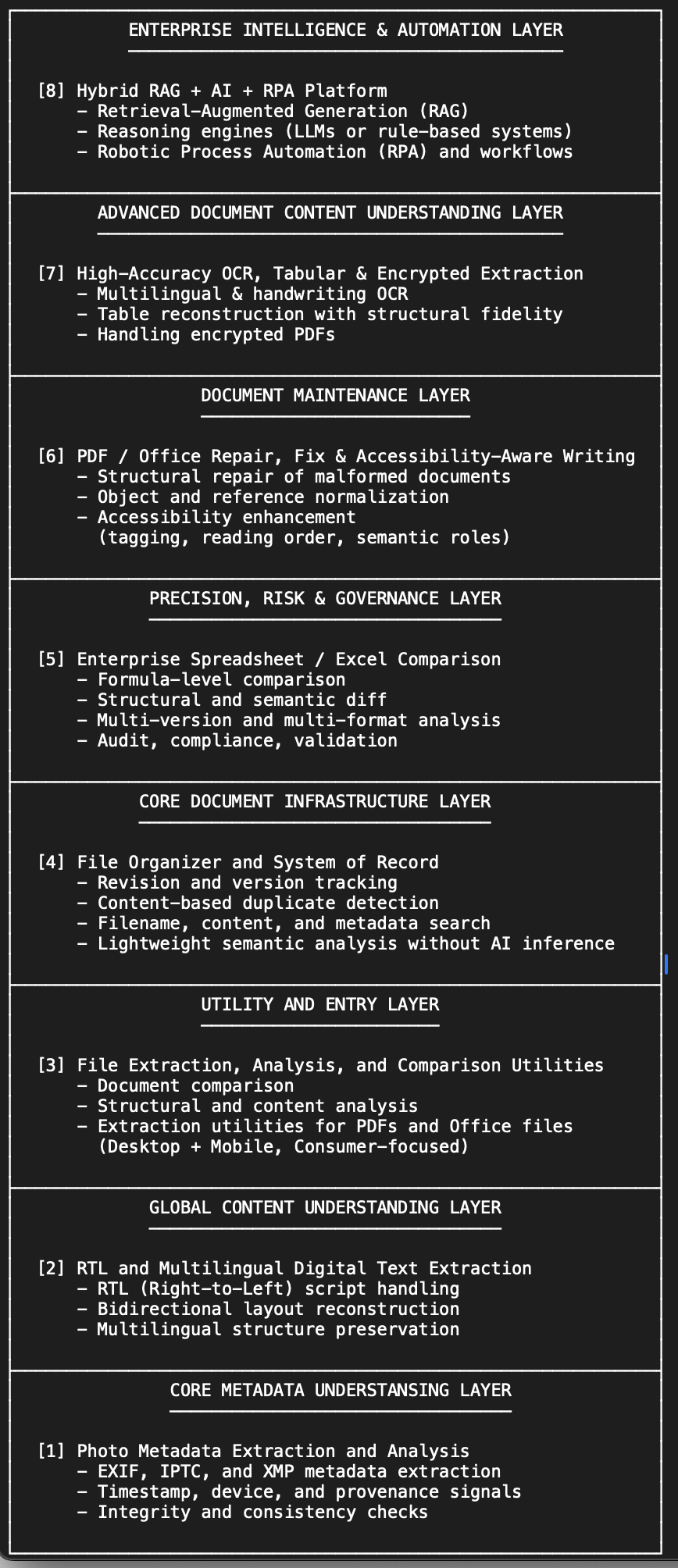
This whitepaper proposes an eight-layer document intelligence architecture that decomposes document-centric systems into modular, composable layers. The objective is to provide a reference architecture for engineers, system designers, and product teams building document processing, analysis, and automation platforms.
1. Introduction
Organizations increasingly depend on unstructured and semi-structured documents: PDFs, Office files, spreadsheets, scanned images, and photos. These documents carry operational, legal, financial, and historical value but remain difficult to manage due to:
- Format fragmentation
- Structural inconsistency
- Multilingual and bidirectional layouts
- Version sprawl and duplication
- Weak linkage between content understanding and automation
Most existing solutions address isolated portions of this problem. A layered architecture enables incremental capability development, clearer system boundaries, and more realistic investment staging.
2. Design Principles
- Layered separation of concerns — Each layer solves a specific class of problems and can evolve independently.
- Composable and non-monolithic — Implementations may skip, replace, or integrate layers selectively.
- Deterministic-first, AI-augmented — Deterministic extraction and analysis remain foundational; AI enhances but does not replace them.
- Progressive complexity — Lower layers emphasize reliability and utility; upper layers emphasize orchestration and intelligence.
3. The 8-Layer Document Intelligence Architecture
This layer integrates Retrieval-Augmented Generation (RAG), reasoning engines, and robotic process automation to connect document understanding with execution.
- Hybrid or local retrieval
- Cross-system orchestration
- Governance, auditability, and compliance controls
This layer extracts structured content from image-based and scanned documents.
- Multilingual and handwriting OCR
- Table reconstruction with structural fidelity
- Encrypted or malformed PDF handling
This layer focuses on document correctness, long-term usability, and compliance rather than content extraction.
- Structural repair and normalization
- Object and reference correction
- Accessibility tagging and reading order repair
This layer addresses the operational risk inherent in spreadsheet-based workflows.
- Formula-level and structural comparison
- Semantic and multi-version analysis
- Audit and compliance support
This layer manages documents over time, acting as a durable system of record.
- Revision and version tracking
- Duplicate detection and metadata indexing
- Content-aware search without mandatory AI inference
This layer provides immediate, user-facing value through focused tools.
- Document comparison and analysis
- Extraction utilities for PDFs and Office files
- Prosumer and desktop-oriented usage
This layer addresses multilingual and bidirectional digital documents.
- RTL and bidirectional layout reconstruction
- Mixed-language document handling
- Language-aware structural preservation
This layer focuses on non-document artifacts and provenance signals.
- EXIF, IPTC, and XMP metadata extraction
- Timestamp, device, and integrity analysis
- Foundations for trust and authenticity systems
4. Architectural Implications
- Progressive adoption — Lower layers can be deployed independently.
- Cost containment — Deterministic layers reduce unnecessary AI inference.
- Integration strategy — Higher layers orchestrate rather than replace lower layers.
5. Conclusion
Document intelligence is not a single technology but a stack of interdependent capabilities. A layered approach enables clearer system design, realistic development paths, and better alignment between technical feasibility and business objectives.
This architecture is intended as a reference framework rather than a prescriptive implementation. Organizations may adopt only a subset of layers depending on their needs, scale, and constraints.
© Document Intelligence Architecture Reference